
Now Reading: Nnamdi Kanu: 5 Reasons the IPOB Leader Was Sentenced to Life Imprisonment After 10 Years of Detention
-
01
Nnamdi Kanu: 5 Reasons the IPOB Leader Was Sentenced to Life Imprisonment After 10 Years of Detention
Nnamdi Kanu: 5 Reasons the IPOB Leader Was Sentenced to Life Imprisonment After 10 Years of Detention


Nnamdi Kanu, the leader of the Indigenous People of Biafra (IPOB), has been sentenced to life imprisonment after 10 years of detention.
According to reports from Global Hints, the court found him guilty on seven terrorism-related charges.
These include the use of Radio Biafra broadcasts to allegedly incite violence, enforcement of unlawful sit-at-home orders across the South-East, and actions considered preparatory acts of terrorism.

The court also highlighted the prolonged legal battles, Kanu’s refusal to defend himself on several occasions, and the wide-ranging regional impacts of IPOB’s activities.
Although the prosecution pushed for the death penalty, the judge opted for life imprisonment, citing global moves away from capital punishment.
The case continues to spark conversation within Nigeria and across the global Igbo diaspora, with political, economic, and security implications for the region.
Watch the video below:
As reported by Global Hints, the court has handed Nnamdi Kanu a life sentence following his conviction on multiple terrorism-related counts. Below are five principal reasons behind this outcome.
1. Nnamdi Kanu’s Conviction on multiple terrorism-related charges

The court found Nnamdi Kanu guilty on seven counts, including leading a proscribed organisation and incitement of violence.
The verdict underscored that his actions went beyond mere speech to criminal acts.
Because the number and nature of the counts were significant, the court deemed life imprisonment appropriate.
2. Nnamdi Kanu’s use of media and broadcast-platforms
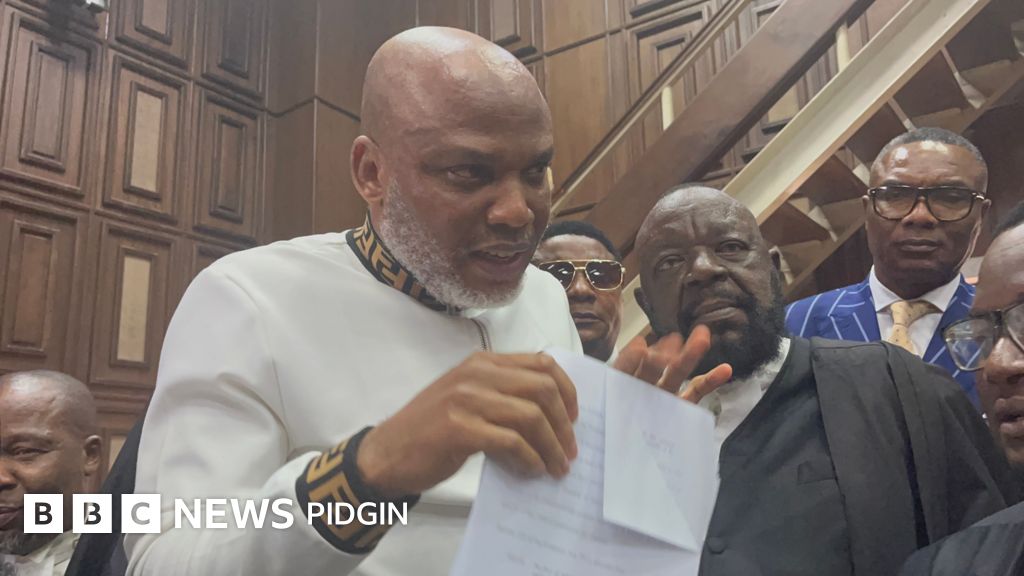
Kanu’s leadership of IPOB included the use of his broadcasting platform (e.g., Radio Biafra) to issue directives, reportedly including instructions for violent actions against state personnel.
The court considered these broadcasts “preparatory acts” of terrorism.
Such use of communication channels amplified the court’s view of the offences’ severity.
3. Nnamdi Kanu’s “Sit-at-home” orders and regional paralysis

Under Kanu’s leadership, IPOB issued weekly “sit-at-home” orders across parts of the South-East region of Nigeria.
The court found that these orders violated citizens’ freedom of movement and amount to coercion, contributing to the judgement of terrorism-linked activity.
The impact on lives, commerce and governance weighed heavily in sentence deliberations.
Read Also:
-
Nnamdi Kanu Removed from Courtroom as Judge Orders Security Agents to Act (VIDEO)
- 5 Reasons Lawyer to Nnamdi Kanu, Aloy Ejimakor, Collapsed in Kuje Prison
- Court Threatens to Shut Down Nnamdi Kanu’s Defence If He Fails to Open Case
4. Nnamdi Kanu’s the protracted detention, trial delays and courtroom behaviour
Kanu’s legal saga spans a decade first his 2015 arrest, bail in 2017, disappearance, re-arrest in Kenya in 2021, and repeated legal motions.
The court noted his repeated procedural challenges, his refusal to defend himself at certain points, and the national security context, all of which influenced the outcome.
5. Nnamdi Kanu’s court decision for life imprisonment

Though prosecutors reportedly sought the death penalty for some counts, the judge ruled that life imprisonment would suffice, citing global trends against capital punishment and the need to temper justice with mercy.
This decision signals a balancing act: recognising the severity of the offences while avoiding the ultimate irreversible punishment.
Read Also:
Nnamdi Kanu: Regional & Diaspora Implications
In addition to Nigeria’s internal legal and security dimensions, the case has broader regional and diaspora implications.
-
The ruling rekindles debates around the 1967–70 secessionist war by the short-lived Biafran War and lingering grievances in the South-East Igbo region.
-
Worldwide Igbo diaspora and pro-Biafra supporters view the trial and sentencing as a political-legal litmus test for ethnic rights and marginalised groups in Nigeria.
-
The court’s verdict may affect foreign-based organisations and broadcast networks linked to IPOB, creating ripple effects in neighbouring West African countries where diaspora networks operate.
-
From a tropical/regional development perspective: the economic cost of disruptions (sit-at-home orders) in the South-East has implications for Nigerian fiscal health and investor perceptions across West Africa.
-
The case also underscores how transnational legal issues extradition from Kenya, British citizenship of Kanu, diaspora activism can have tropical/regional ramifications for governance and interstate cooperation.
The sentencing of Nnamdi Kanu represents a landmark moment in Nigeria’s handling of separatist agitation, terrorism law and regional unrest.
The five reasons above outline the key legal and contextual factors behind the life sentence from broadcast-driven incitement, regional paralyses, long detention and courtroom conduct, to the choice of life incarceration instead of death.
With both national and diaspora attention fixed on the case, its tropical/regional significance reverberates beyond the courtroom.
This article is based on the report from Global Hints.
Related Posts



Previous Post
Next Post



Global Hints
Follow us for the Latest News, Entertainment, Politics, Business, Technology, and World updates, delivered fast and verified on WhatsApp!
🚀 Follow Us on WhatsApp